Expanding the Indications for Meniscus Transplantation
SRF research demonstrated that meniscus allograft transplantation can be successful in patients over 50 with significant arthritis, expanding treatment options for patients who might otherwise proceed directly to knee replacement.
Meniscus allograft transplantation was traditionally indicated for patients under age 50 with limited arthritis. Older age and arthrosis (degenerative arthritis) were commonly viewed as contraindications, ruling many patients out for the procedure.
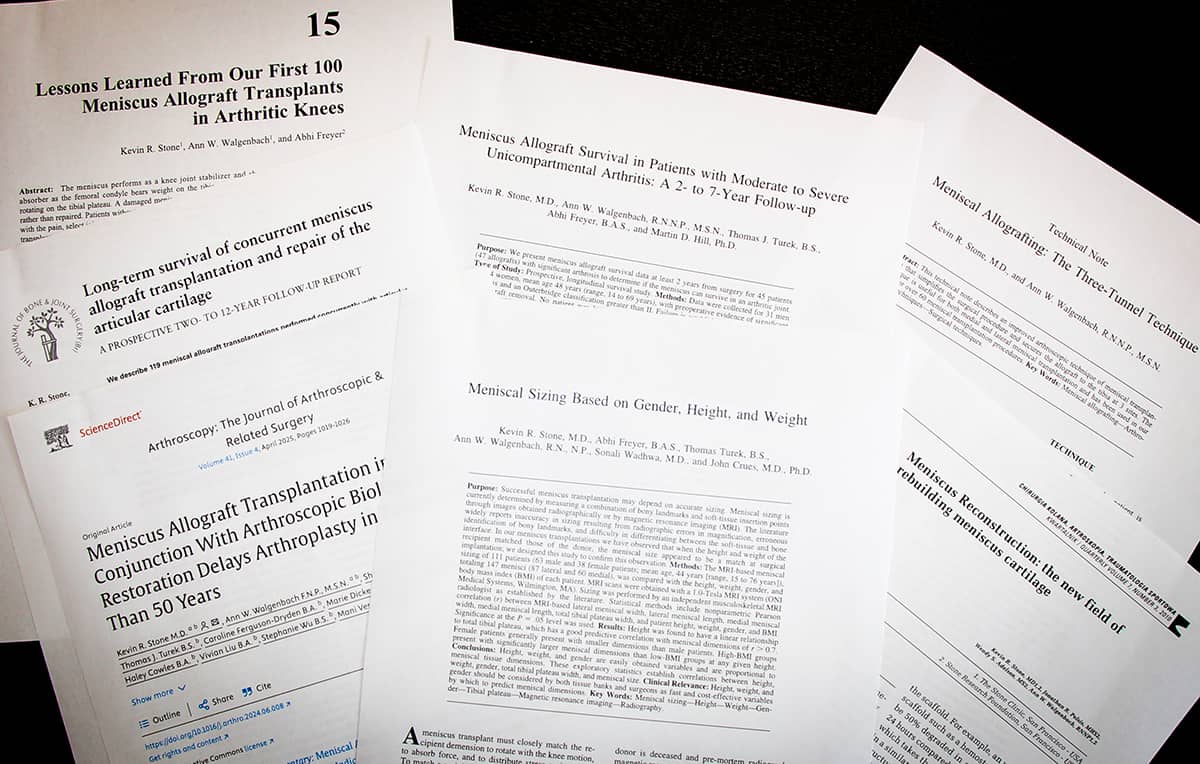
In a long-term study, SRF examined patients over 50 with arthritic knees who had previously been advised to undergo arthroplasty (knee replacement surgery). The findings showed that meniscus allografts, used in conjunction with arthroscopic biologic knee repair procedures, can survive in arthritic knees, improve pain and function, and delay artificial knee replacement
Publication: Arthroscopy (2024)
Supporting a Return to Sports After Meniscus Transplantation
SRF research established that patients with moderate to severe articular cartilage damage can return to sporting activities after meniscus allograft transplantation, challenging the belief that advanced cartilage damage should rule out both the procedure and a return to sports.
Meniscus allograft transplantation had already been shown to reduce pain and improve function in patients with missing or irreparable menisci. However, there was limited evidence about whether active patients with severe articular cartilage damage could achieve similar outcomes and resume sporting activities.
In a longitudinal (long-term) study of 49 patients, SRF found that meniscus allograft transplantation provided significant improvements in pain and function in the medium to long-term. In conjunction with the transplantation, 41 patients also underwent a procedure to repair their articular cartilage damage. The majority of patients achieved their goal of participating in sporting activities, and the transplant had an estimated mean survival time of 12.6 years. These findings supported meniscus allograft transplantation as a viable surgical option for active patients with severe cartilage damage and missing or irreparable menisci.
Publication: Knee Surgery, Sports Traumatology, Arthroscopy (2014)
Simplifying Donor Matching for Meniscus Transplantation
SRF research showed that height, weight, and sex can help predict meniscal dimensions, providing tissue banks and surgeons with a faster, more cost-effective method for matching donor tissue to transplant recipients.
Accurate sizing is important because a transplanted meniscus must closely match the recipient’s anatomy. Traditional sizing methods rely on radiographs or MRI and can be difficult to apply consistently.
SRF found that these simple anthropometric measurements were correlated with meniscal size. The findings established a practical approach that can streamline donor-recipient matching for meniscus allograft transplantation.
Publication: Arthroscopy (2007)