Back to Research
2 Studies

Ligaments & Tendons

Ligaments and tendons provide the stability required for joint movement and athletic activity. SRF tracks outcomes across knee and ankle ligament and tendon procedures, with a particular focus on the anterior cruciate ligament (ACL), one of the structures most frequently injured during sports. Our research explores more effective methods of ACL reconstruction.

20 Years

Longest Follow-up

30+

Years Developing Technique

50%

Xenograft Study Success

250,000

ACL Injuries/Year (US)

About This Research Area

The current standard for ACL reconstruction involves grafting either autologous (patient's own) or allogeneic (cadaver) tendons. Both methods have disadvantages: autograft harvest creates a second surgical site with increased pain and morbidity (complications and recovery burden), while many allogeneic tendons come from elderly individuals with reduced biomechanical capacity.

Our research has explored two alternatives: using stronger alternative donor (allograft) tissues along with a more effective placement surgical technique, and, more experimentally, "humanizing" porcine tissue to potentially create a new source of durable tissue.

Clinical Significance

Avoiding a Second Surgical Site in ACL Reconstruction

SRF advanced a reproducible ACL reconstruction technique that uses a strong donor quadriceps tendon, allowing patients to avoid the additional pain and recovery associated with harvesting tendon from another part of their own body.

Traditional autograft reconstruction requires surgeons to remove tendon from the patient, creating a second surgical site that can add pain and morbidity. The three-incision technique instead uses allograft (donor) tissue while supporting accurate graft placement and consistent fixation, including during complex revision surgery.

Early outcomes were comparable to reconstruction using a graft taken from the patient’s own patellar tendon, without the same risk of pain at the front of the knee. Patients returned to sports on a similar timeline, with twisting activities delayed for six to 12 months. Further research is needed to evaluate long-term re-rupture rates.

Clinical Significance

Exploring a Novel Source of Strong Graft Tissue

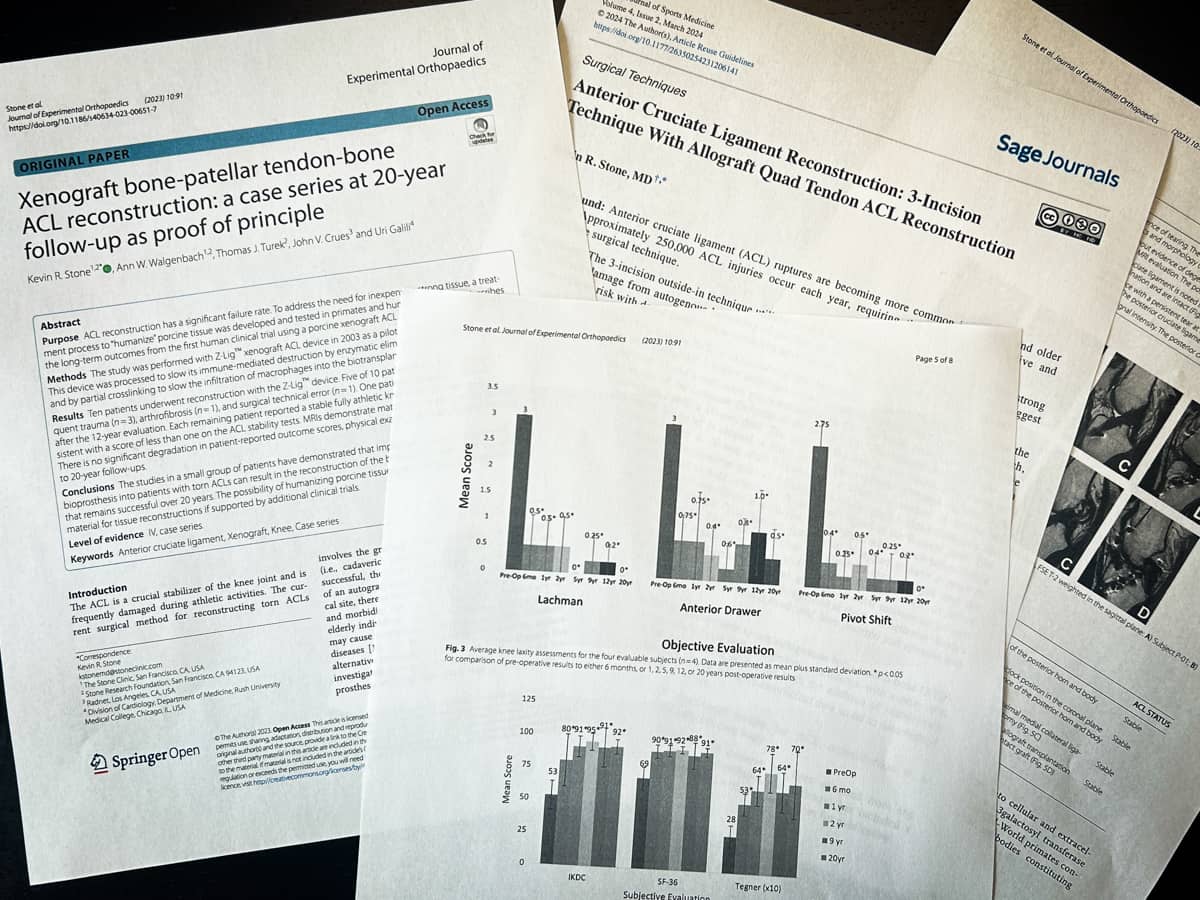
SRF research provided proof of principle that a porcine xenograft (animal-derived tissue graft) could be processed through an enzymatic treatment for ACL reconstruction and gradually remodel into functional ligament tissue.

In a 10-patient study, the graft was treated to reduce immune rejection and support gradual replacement by the patient’s own cells. Five reconstructions remained successful at 12 years, with four available at 20 years showing stable, functional knees and mature graft remodeling on MRI.

Although further clinical trials are required, the approach could provide a strong and inexpensive source of graft tissue.

Current Research Projects

SRF tracks long-term outcomes across ligament and tendon procedures, using these findings to identify opportunities for stronger grafts, more durable reconstruction, and improved return to activity.

Patient Stories

See how ACL reconstruction has helped athletes return to full activity.

No videos found.

Surgical Technique Videos

Surgical Technique

ACL Reconstruction

Our ACL reconstruction involves a three-portal technique using donor tendon after arthroscopic treatment of associated injuries.

View Full Details
Complex Reconstruction

Knee Dislocation Repair

Multi-ligament reconstruction for knee dislocation injuries, addressing ACL, PCL, and posterolateral corner damage.

View Full Details
Surgical Technique

Ankle Ligament Reconstruction

Anatomic reconstruction of the lateral ankle ligaments using allograft tissue for chronic ankle instability.

View Full Details

Published Studies

Showing 2 of 2 studies

Ligaments & Tendons Knee 2023

Xenograft Bone-Patellar Tendon-Bone ACL Reconstruction: A Case Series at 20-Year Follow-up as Proof of Principle

Kevin R. Stone, Ann W. Walgenbach, Thomas J. Turek, John V. Crues, Uri Galili

Research Question: Can pig ligament tissue be "humanized" and successfully used for ACL reconstruction in humans?

The possibility of humanizing porcine tissue opens the door to unlimited clinical material for tissue reconstructions if supported by additional clinical trials.

Key Finding: First demonstration that "humanized" porcine ligament can remodel into functional autologous ACL over 20 years.

Journal of Experimental Orthopaedics View Publication
Ligaments & Tendons Knee 2024

Anterior Cruciate Ligament Reconstruction: 3-Incision Technique With Allograft Quad Tendon ACL Reconstruction

Kevin R. Stone

Research Question: How can ACL reconstruction be performed without harvesting tissue from the patient?

The 3-incision technique with allograft quadriceps tendon for ACL reconstruction is a reproducible surgical technique that avoids harvesting from the patient's own body.

Key Finding: The 3-incision allograft quadriceps tendon technique provides a reproducible approach for ACL reconstruction while avoiding tissue harvest from the patient's own patellar tendon or hamstrings.

Video Journal of Sports Medicine View Publication