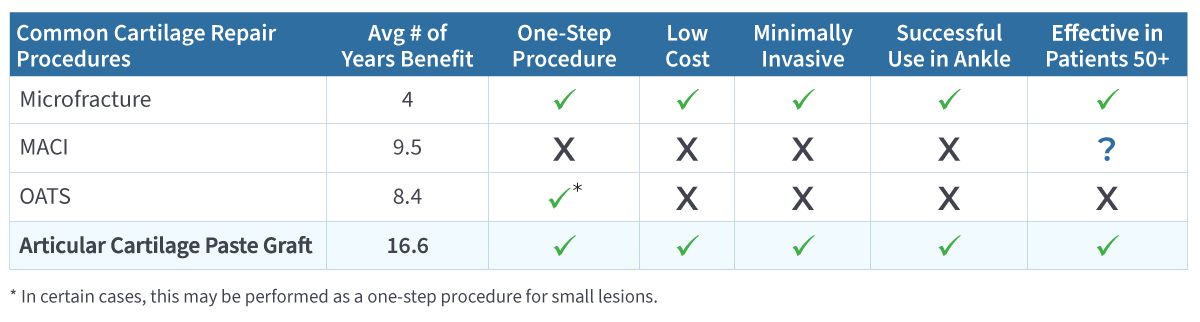
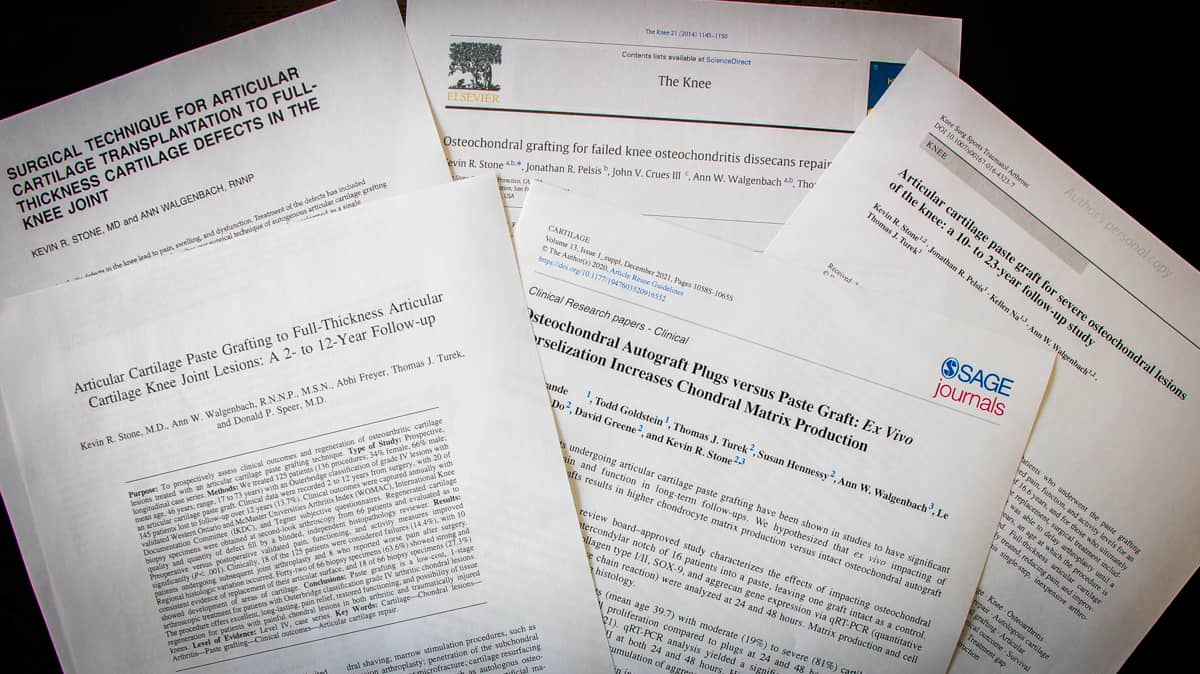
For more than three decades, SRF’s clinical research has shown that the Articular Cartilage Paste Graft (ArtCart) can regenerate cartilage, reduce pain, improve function, and help patients return to athletic activity for many years. These long-term results distinguish ArtCart as a single-step, minimally invasive approach that can restore damaged cartilage while helping patients preserve their natural joints and remain active.
ArtCart was developed by Kevin R. Stone, MD, in 1991 as a regenerative treatment for damaged cartilage. The procedure uses healthy cartilage and bone harvested from the patient, which are processed into a paste and impacted into the damaged area. Unlike many cartilage repair techniques, ArtCart is performed arthroscopically in a single surgical session, uses autologous (patient’s own) tissue, and can treat both large and small cartilage lesions.
No commonly practiced one-step surgical procedure can reliably regenerate durable articular cartilage and deliver long-term results, despite osteoarthritis (OA) affecting more than 595 million people worldwide. As cartilage damage progresses toward osteoarthritis (OA), patients may lose the ability to work, participate in sports, and move without pain. Careers can be shortened, activities abandoned, and quality of life diminished.
The few available cartilage repair options are limited, expensive to perform, and often inaccessible because of insurance restrictions. Many patients with arthritic knees are therefore left without an effective treatment, forcing them to live for years with worsening pain and loss of mobility.
SRF is building on ArtCart’s long-term clinical success by developing ArtCart+, a major advancement intended to make cartilage regeneration more effective, reproducible, and accessible to more patients. In collaboration with leaders in regenerative medicine, molecular biology, tissue engineering, and veterinary surgery, SRF is working to improve the quality, speed, and durability of cartilage regeneration. Our goal is to transform a procedure with decades of successful outcomes into a more widely available solution that can help more patients avoid or delay knee replacement while extending its benefits into veterinary care.